Why Your Scalp and Part Line Burn During Outdoor Training
Quick Answer: Your part line is exposed skin with no hair shading it and it almost never gets sunscreen, so it burns faster than your face. Training makes it worse: you are outdoors at peak hours, sweat dilutes and moves any product you did apply, and a tight ponytail widens the part and exposes more scalp. Use a powder or spray SPF designed for scalp, reapply every two hours, and change your part regularly. September sun is lower but still strong enough to burn - and the cooler air removes the sensation that normally warns you.
A burnt scalp is painful for days, it peels visibly, and repeated burning there carries the same long-term risk as anywhere else on the body. It is worth two minutes.

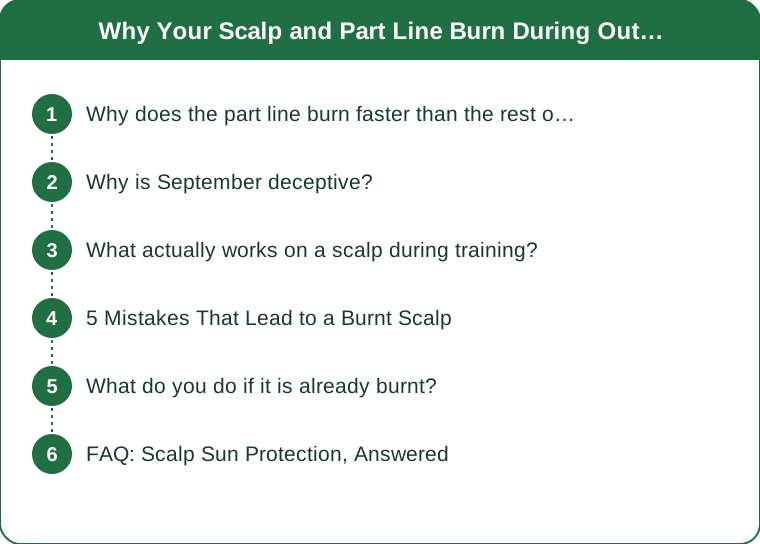
Why does the part line burn faster than the rest of your head?
Because it is bare skin with no hair over it, and hair is genuinely effective sun protection. A full head of hair provides substantial shading; a parting removes it in a two-centimetre strip.
The scalp sits at the top of the body, facing the sun directly. The angle of incidence is close to perpendicular through the middle of the day, which is the worst possible orientation.
Nobody applies sunscreen there. Facial sunscreen stops at the hairline, and that is exactly where the exposed strip begins.
Tight styles make it worse. A tight ponytail, a slicked-back bun, or braids pull hair away from the scalp and widen the exposed area substantially - which is precisely the style most people train in.
Thinning hair increases the exposed area steadily, and this is one of the reasons scalp burns become more common with age without anyone changing their habits.
And the scalp does not feel it building. The sensation of a burn developing is far less noticeable through hair, so the usual early warning does not arrive.
Why is September deceptive?
Because the air is cooler and the sun is not proportionally weaker. UV levels in early September are meaningfully lower than in June but still well within the range that causes burns in unprotected skin.
Heat is what makes people apply sunscreen, and heat is what has gone. The behavioural trigger disappears before the risk does, which is the whole problem.
Training moves back to the middle of the day. Through summer, many people run or cycle early to avoid the heat. As it cools, sessions drift back towards late morning and midday - which is when UV peaks.
Sessions get longer as it gets more comfortable. A 45-minute run in August heat becomes a 90-minute run in September, doubling the exposure at the exact moment people stop protecting for it.
Reflected UV rises off wet surfaces, and autumn brings more wet ground, more water, and more low-angle light bouncing upwards.
And the low sun angle changes what gets hit. A high summer sun burns the top of the head; a lower autumn sun reaches the face, ears, and the sides of a part in a way midsummer does not.
What actually works on a scalp during training?
Powder SPF is the most practical option for a part line. It is applied with a brush directly along the parting, does not make the hair greasy, and can be reapplied without redoing your hair. This is the single most useful product for this problem.
Spray SPF designed for scalp works well and needs technique. Part the hair, spray directly along the line from a few centimetres, and rub it in with a fingertip. Spraying over the top of the hair mostly coats hair, not scalp.
Ordinary facial sunscreen works and most people will not tolerate it. It is greasy in hair and flattens the roots. Fine for a one-off, not for a routine.
A hat is more reliable than any product. A cap protects the part completely and a wide brim protects ears and neck as well. A running cap with mesh panels is comfortable across a broad temperature range.
A buff or headband covers the part on cooler days and doubles as sweat management.
And change your part every few days. It reduces cumulative exposure on any single strip of skin, and it has a useful side effect of reducing the flattening that a permanent part causes.

5 Mistakes That Lead to a Burnt Scalp
1. Stopping sunscreen at the hairline. The universal one. Facial application ends exactly where the exposed scalp begins.
2. Assuming hair is enough protection. It is over most of the head and it is nothing at all over a parting, and thin or fine hair provides less than people assume.
3. Applying once before a long session. Sweat dilutes and moves sunscreen, and a two-hour ride or run needs reapplication regardless of what the bottle claims about water resistance.
4. Trading the hat for a headband as it cools. The third mistake catches out a lot of runners in September - the cap comes off because it is no longer hot, and the protection goes with it while the UV does not.
5. Ignoring the ears and the back of the neck. A ponytail exposes the neck completely, and ears are among the most commonly burnt and most commonly missed areas on the body.
A sixth: forgetting the scalp on overcast days. A significant proportion of UV passes through cloud, and cloudy days remove the heat cue entirely while leaving much of the risk.
What do you do if it is already burnt?
Cool it and leave it alone. A cool shower, a gentle non-fragranced conditioner, and no heat styling until it settles.
Avoid tight styles while it heals. A tight ponytail on burnt scalp is genuinely painful and adds mechanical stress to skin that is already damaged.
Expect flaking in three to five days and do not pick it. Scalp peel looks like dandruff and is not, and treating it with an anti-dandruff shampoo will sting and dry it further.
Skip the actives. No exfoliating scalp treatments, no salicylic acid scalp products, no strong clarifying shampoo until it has fully healed.
Cover it completely when you go back out. Burnt skin re-burns easily, and a hat is the only reliable answer while it heals.
Seek medical advice for blistering, a burn covering a large area, or any burn accompanied by feeling unwell. That is a more serious burn than a red part line and needs proper attention.
And check the area periodically over the long term. The scalp is a common site for skin cancers and a difficult one to see, so it is worth asking a hairdresser to mention anything unusual, or having someone look occasionally. Any new mole, sore that does not heal, or persistent scaly patch on the scalp should be seen by a doctor.
This is general information, not medical advice.
FAQ: Scalp Sun Protection, Answered
Does hair protect the scalp from the sun?
Over most of the head, substantially. Along a parting, not at all. Thin or fine hair provides noticeably less than thick hair, and any style that pulls hair tight increases the exposed area.
What is the best sunscreen for a scalp?
A powder SPF applied along the part with a brush is the most practical for people who train, because it reapplies easily and does not make the hair greasy. Scalp-specific sprays are the next best option.
Do I need this in autumn?
Yes for the first half of it. UV in September is lower than midsummer and still high enough to burn unprotected skin, and the cool air removes the sensation that usually prompts people to cover up.
Will sunscreen in my hair damage it?
No, though most formulas leave it greasy and flat until washed. That is a cosmetic issue, which is exactly why powder formulas exist.
What about a hat that makes me overheat?
A mesh-panel running cap or a light visor with a buff over the part solves this. On very hot days, a cap is still usually cooler than a burnt scalp.
TL;DR:
- A part line is bare skin the hair no longer shades, and facial sunscreen almost always stops at the hairline.
- Tight ponytails and slicked-back styles widen the exposed strip, and thinning hair increases it over time.
- Powder SPF applied with a brush along the part is the most practical option for training; a cap is more reliable than any product.
- Reapply every two hours - sweat dilutes and moves sunscreen regardless of water-resistance claims.
- Change your part every few days to spread cumulative exposure.
September is the deceptive month: sessions get longer and drift back towards midday, the cap comes off because the heat has gone, and the UV has not dropped nearly as much as the temperature has.
Keep Reading
This article is for general informational and styling purposes only. Fit, sizing, and product availability may vary.