Dry Shampoo Between Workouts Is Masking the Problem, Not Actually Solving It
Quick Answer: Dry shampoo absorbs surface oil and adds fragrance. It doesn’t remove sweat residue, and it doesn’t undo the pH and microbial changes sweat causes at the scalp. Used as a substitute for most washes, it stacks its own residue on top of the sweat. Match wash frequency to actual sweat level, add a clarifying wash occasionally, and rinse with plain water after hard sessions.
Five workouts this week, two shampoos, and dry shampoo covering the gap. Your hair looks fine. Your scalp has opinions.
The itch, the persistent faint smell that comes back an hour after spraying, the flakes that aren’t quite dandruff — that’s the gap the can isn’t closing.

Does Dry Shampoo Actually Clean Your Hair?
No. It does two specific things, and neither is cleaning.
It absorbs surface oil, usually with starch or clay-based powders. That’s a real effect and it genuinely improves how hair looks and feels.
It adds fragrance, which covers odor.
What it doesn’t do is remove anything. Sweat residue stays. Salt stays. The bacterial and pH changes sweat produced at the scalp stay. Nothing has left your head — you’ve added an absorbent powder on top of what was already there.
And that’s the part worth being honest about: repeated no-wash use means the powder itself accumulates. Now the scalp is dealing with the original sweat residue plus layers of dry shampoo plus whatever styling product was already there.
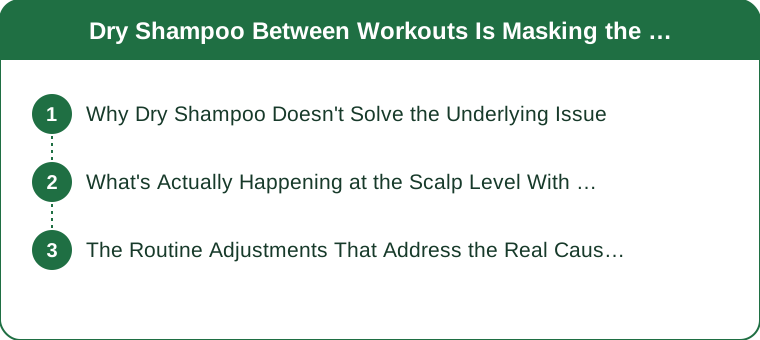
What Is Sweat Actually Doing to Your Scalp?
Sweat changes the scalp’s surface pH and the immediate microbial environment on it. Left in place repeatedly, that shift can contribute to irritation, itching, or a persistent odor that reappears fast after any fragrance fades.
That last detail is a useful diagnostic. If the smell comes back within an hour or two of spraying, that’s odor being masked rather than removed — the source is still there.
The residue side compounds it. Combined styling product and dry shampoo buildup can accumulate around follicles over an extended period. This isn’t a dramatic overnight problem; it’s a slow one, which is exactly why it’s easy to miss until the scalp starts complaining.
None of this means dry shampoo is bad. It means it’s a styling product being asked to do a hygiene job.

Myth vs. Fact
Myth: Washing hair often damages it, so dry shampoo is the safer choice. Fact: The concern about frequent washing is mostly about the lengths drying out. The scalp and the lengths have different needs — you can wash the scalp regularly and condition the lengths accordingly.
Myth: Dry shampoo cleans, just without water. Fact: It absorbs and masks. Nothing is removed from your scalp.
Myth: If my hair doesn’t look greasy, my scalp is fine. Fact: Appearance tracks surface oil, which is the one thing dry shampoo does address. Residue and pH changes are invisible.
Myth: More sprays fix a stubborn smell. Fact: More sprays add more residue to the thing causing the smell.
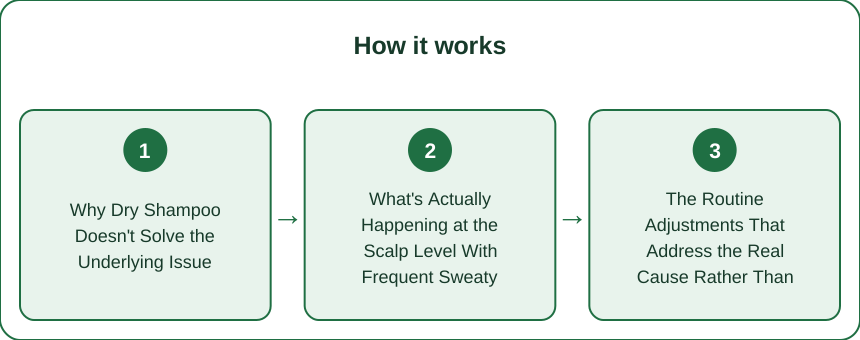
What Should You Actually Do Between Workouts?
Three adjustments, none of them “wash every day.”
1. Calibrate wash frequency to actual sweat, not to a fixed schedule. A light yoga class and a hot spin session are not the same input. If you trained hard and sweated heavily, that session deserves a wash rather than a spray. If you barely broke a sweat, dry shampoo is doing exactly what it’s good at.
2. Add an occasional clarifying wash. Roughly every week or two, depending on how much product you use, a clarifying shampoo clears the compounded residue that regular shampoo alone may not fully remove. Follow it with conditioner on the lengths — clarifying is effective precisely because it’s stripping.
3. Use a plain water rinse after sweaty sessions. This is the underrated one. No shampoo, just water through the scalp for 30–60 seconds. It removes real sweat residue far more effectively than dry shampoo does, without the drying effect of another full wash. For anyone training five or six days a week, this single change does most of the work.
Practically, less sweat reaching your scalp helps too. A moisture-wicking headband, hair tied up rather than down, and technical fabrics rather than cotton all reduce how much sweat sits there. The same logic behind moisture-wicking high waist leggings applies six feet higher up: cotton holds sweat against you, technical fabric moves it away.
When to see a professional: persistent itching, flaking, redness, sores, or noticeable hair shedding are worth a dermatologist’s assessment rather than another product change. This is general information, not medical advice.
FAQ
How often should I wash my hair if I work out daily?
There’s no single right number — it depends on hair type, sweat level, and product use. A common workable pattern is a full wash 2–4 times a week, water-only rinses after the sweatiest sessions in between, and dry shampoo reserved for the light days.
Is dry shampoo bad for your hair?
Used occasionally as intended, it’s fine. The problem is using it as a replacement for washing over long stretches, which lets residue build up on an already sweat-affected scalp.
Does a water-only rinse really do anything?
Yes — sweat is largely water and salt, and plain water removes a meaningful portion of that residue. It won’t remove oil or styling product, which is why it supplements washing rather than replacing it.
TL;DR
- Dry shampoo absorbs oil and masks odor. It removes nothing and doesn’t address sweat’s pH or microbial effects.
- Residue compounds when it’s used as a substitute for most washes.
- Fast-returning odor is the tell that you’re masking rather than cleaning.
- Do this instead: match wash frequency to real sweat level, clarify every week or two, and rinse with plain water after heavy sessions.
- See a dermatologist for persistent itching, flaking, sores, or shedding.
Keep Reading
This article is for general informational and styling purposes only. Fit, sizing, and product availability may vary.