Hard Water Is Probably Why Your Hair Feels Coated After the Gym
Quick Answer: Hard water deposits calcium and magnesium onto the hair shaft, and they build up faster the more often you wash. The result is hair that feels coated, looks dull, resists conditioner and tangles more. A chelating or clarifying shampoo once every one to two weeks removes the deposit, and a leave-in applied before the shower reduces how much binds in the first place.
If you shower at the gym four times a week, you are exposing your hair to roughly twice the mineral load of someone who showers once a day at home.

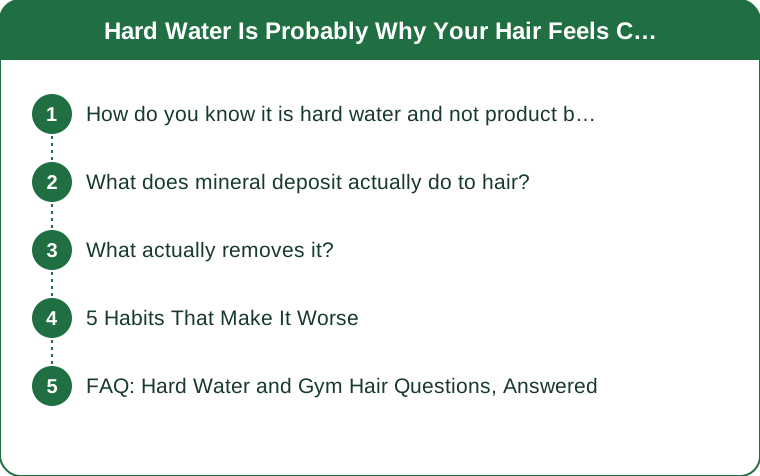
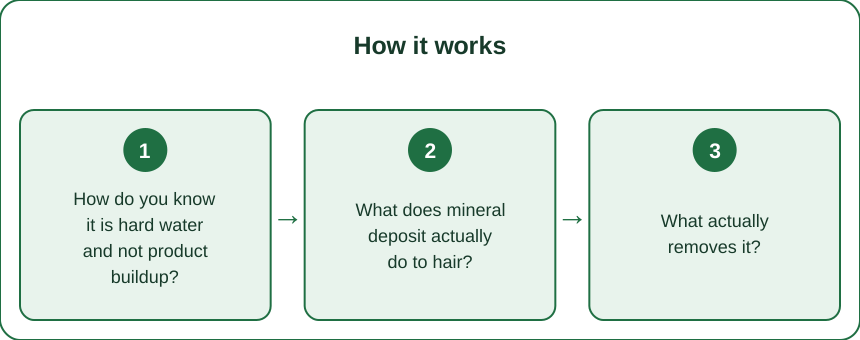
How do you know it is hard water and not product buildup?
The two feel similar and have different fixes, so it is worth distinguishing.
Signs pointing to hard water:
- Shampoo does not lather well and you use more than you expect
- A film or squeaky-then-sticky feeling on the hair after rinsing
- Soap scum on the shower walls and white crust on the tap
- The problem is worse at the gym than at home, or vice versa — the location difference is the strongest clue
- Color-treated hair fading or shifting brassy faster than it should
Signs pointing to product buildup:
- The problem concentrates at the roots and scalp rather than along the length
- It correlates with a specific product, especially silicone-heavy conditioners or dry shampoo
- It resolves with one clarifying wash and stays resolved for weeks
They compound each other. Minerals give product residue something to cling to, and the combined deposit is harder to remove than either alone. Someone using dry shampoo between gym sessions and washing in hard water gets both layers.
How to check the water: hard water test strips are inexpensive and give a reading in minutes. Your local water utility also publishes hardness data. Worth knowing the number rather than guessing.
What does mineral deposit actually do to hair?
Three things, in order of how noticeable they are.
It coats the cuticle. Calcium and magnesium ions bind to the negatively charged hair surface and deposit as a mineral layer. That layer scatters light, which is why hard-water hair looks dull rather than shiny even when it is healthy.
It stops conditioner working. Conditioners are cationic — they work by binding to the hair’s negative charge. If minerals already occupy those sites, the conditioner has nothing to bind to and simply rinses away. This is why people in hard water areas keep buying richer conditioners that do not help.
It roughens the surface and increases tangling. A mineral-coated cuticle has more friction, which means more tangles, more mechanical damage during brushing, and more breakage over time — particularly at the ends.
On color-treated hair it is worse. Mineral deposits interfere with color and can produce brassiness or a dull cast, and iron in the water can turn blonde and gray hair orange. If your color is behaving unpredictably and you shower at multiple locations, water chemistry is a genuine variable.
Timeline: this is cumulative, not immediate. It builds over weeks, which is why it feels like your hair “gradually got worse” with no identifiable cause.

What actually removes it?
One product type does most of the work, and the rest is prevention.
Chelating shampoo — the actual fix. Chelating agents such as EDTA bind mineral ions and lift them off the hair. This is different from a standard clarifying shampoo, which removes oils and product residue but does far less to minerals. Read the ingredient list for EDTA or a similar chelator.
Frequency: once every one to two weeks if you wash in hard water frequently. More than that is drying — chelating shampoos are stripping by design, and they should always be followed by a deep conditioner or mask.
A vinegar rinse as a mild alternative. Diluted apple cider vinegar, roughly one part to four parts water, lowers pH and helps release some mineral binding. Considerably gentler and considerably less effective than a chelator. Fine for maintenance between chelating washes.
Prevention: the pre-shower leave-in. Apply a leave-in conditioner or a light oil to the lengths and ends before you get in the shower. This occupies the binding sites and creates a barrier, so less mineral deposits during the wash. It is the single most useful habit for people who shower at the gym.
A shower filter, if you have control of the shower. Reduces mineral and chlorine content meaningfully. Not an option in a gym locker room, but worth it at home if your water is genuinely hard.
Rinse cool at the end. Cooler water helps the cuticle lie flatter and reduces how much deposit is trapped under a raised cuticle.
5 Habits That Make It Worse
1. Washing every single session. If you train four to six times a week, washing every time doubles or triples your mineral exposure compared to most people. Rinsing with water only, or using a co-wash, is enough after most sessions. Full shampoo two to three times a week is plenty for the majority of hair types.
2. Layering dry shampoo on top. Dry shampoo between gym sessions adds a starch layer over the mineral layer. The combination is far harder to remove and considerably heavier at the roots.
3. Very hot water. Heat raises the cuticle, which increases how much mineral gets trapped underneath. Gym showers often run hotter than home showers.
4. Skipping conditioner because hair feels heavy. The heaviness is deposit, not conditioner. Skipping conditioner leaves the cuticle rougher, which increases tangling and breakage. The fix is chelating, not omitting.
5. Brushing wet, coated hair aggressively. Mineral-coated wet hair has high friction and is at its weakest. A wide-tooth comb from the ends upward, with a detangler, is the difference between maintenance and breakage.
The compounding one: doing all five at once, which is a fairly normal gym routine, and then concluding your hair is just difficult.
FAQ: Hard Water and Gym Hair Questions, Answered
Can I bring my own water to rinse with?
Some people do a final rinse with a bottle of distilled or filtered water, and it does help as a last step. It is impractical as a full wash but perfectly workable as a 30-second finish.
Does hard water cause hair loss?
There is not good evidence that it causes hair loss directly. It does cause breakage through increased friction and tangling, and breakage can look like thinning. If you are seeing genuine shedding from the root rather than snapped mid-shaft strands, that is a different issue worth discussing with a clinician. This is general information, not medical advice.
Will a chelating shampoo strip my color?
It can lift some color, particularly semi-permanent and vivid shades. Use it before a color appointment rather than after, and follow with a deep conditioner. For color-treated hair, some brands make gentler color-safe chelating formulas.
How fast will I notice a difference?
Usually after the first chelating wash — the shine and slip return immediately if minerals were the problem. If one chelating wash changes nothing, the cause is likely something else.
TL;DR:
- Hard water deposits calcium and magnesium on the hair shaft, and frequent gym showers multiply the exposure.
- The deposit dulls shine, blocks conditioner from binding, and increases tangling and breakage.
- Use a chelating shampoo with EDTA every one to two weeks, always followed by a deep conditioner.
- Apply a leave-in before you shower to occupy binding sites — the highest-value habit for gym washers.
- Cut wash frequency, drop the water temperature, and lay off the dry shampoo layering.
If your hair got gradually heavier and duller with no obvious cause and you shower at the gym, test the water before buying another conditioner.
Keep Reading
This article is for general informational and styling purposes only. Fit, sizing, and product availability may vary.