How Long Can You Leave Sweaty Hair Tied Up After a Workout?
Quick Answer: Aim to take sweaty hair down within about an hour. Wet hair is at its weakest and most stretchable, so an elastic holding it under tension for hours creates a lasting bend and concentrated breakage at one point. The scalp side matters too - trapped moisture and sweat under a tight style for hours creates conditions that irritate the scalp and feed the microbes behind itch and odor.
Taking it down and letting it dry loose costs nothing and prevents most of the damage.
Why is wet hair so much more vulnerable?
Because water changes the mechanical properties of the fiber, and not slightly.
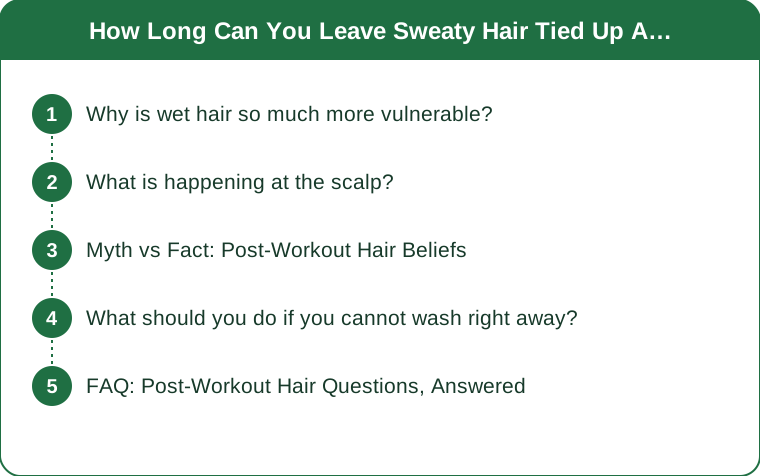
Hair is a protein structure held together partly by hydrogen bonds. Water disrupts those bonds temporarily, which is exactly why wet hair can be reshaped and why it dries into whatever configuration it was held in. It is also why wet hair stretches far more than dry hair before it breaks - and stretching past a certain point causes permanent damage to the internal structure even when the strand does not visibly snap.
Sweat-damp hair is in this softened state. Add an elastic pulling it into a bundle, add the weight of the hair itself, add head movement, and you have a fiber at its most deformable held under sustained tension at one specific point.
Three consequences follow:
- A set bend at the elastic line. Hair dries in the shape it was held. A ponytail left in for hours dries with a kink exactly where the elastic sat, and that bend is a weak point that catches and breaks in future brushing.
- Concentrated mechanical stress. All the tension of a ponytail focuses on a narrow band. Hours of it in the softened state produces the short broken hairs that show up as a halo of flyaways at the same height on every strand.
- Cuticle abrasion. Damp hair against an elastic, moving as you move, abrades the cuticle at the contact point more readily than dry hair would.
The practical upshot: the same hairstyle that is fine for a 45-minute class becomes a damage source when it stays in for five hours. The style is not the problem. The duration in a damp state is.
What is happening at the scalp?
A humidity chamber, essentially, and the scalp responds to that the way skin responds to any occlusion.
Sweat is mostly water with salts and small amounts of urea and lactate. Under a tight style, that mixture stays against the scalp instead of evaporating, and the microclimate stays warm and damp for as long as the style stays up.
That matters because the scalp carries a normal population of microbes, including Malassezia yeasts that live on scalp oils. They do well in warm, damp, occluded conditions. Extended sweaty occlusion tips the balance in their favor, and the results people notice are:
- Itching that starts hours after the workout, not during it - the delay is the microbial response, not the sweat itself
- Flaking, which is frequently misread as dryness and treated with heavier oils, which makes it worse
- Odor that persists after washing, because the source is at the scalp rather than in the hair lengths
- Small bumps along the hairline where occlusion is highest
There is a second factor: salt. As sweat evaporates, salts are left behind on the scalp and hair. Salt is drying and mildly abrasive, and it stays until it is rinsed off. Leaving hair up means much of that salt stays trapped against the skin rather than being brushed or aired away.
The useful correction: taking hair down is a scalp intervention as much as a hair one. Even if you cannot wash immediately, releasing the style lets moisture evaporate and cuts the occlusion window dramatically.

Myth vs Fact: Post-Workout Hair Beliefs
Myth: You must wash your hair after every sweaty workout. Fact: Not necessary for most people, and over-washing has its own costs. What matters more is rinsing the scalp and letting it dry. A water-only rinse removes most salt and sweat and is far gentler than daily shampooing. Fine, oily hair may need more frequency; coarse or curly hair usually needs less.
Myth: Dry shampoo solves the problem. Fact: Dry shampoo absorbs oil and adds fragrance. It does nothing about the salt, the moisture, or the scalp microclimate, and layering it onto a sweaty scalp adds product to an already occluded surface. It is a styling tool for the lengths, not a scalp cleanser.
Myth: A tighter style protects hair during exercise. Fact: A tighter style creates more tension, and tension is the mechanism of damage. What you want is a style that stays put with the least tension possible - which usually means a lower placement and a wider fastening rather than a tighter one.
Myth: Silk scrunchies are marketing. Fact: The material genuinely matters. A thin elastic concentrates force on a very narrow band; a wide, smooth fastening spreads it. Silk and satin also generate less friction against the cuticle. It is one of the few hair products where the mechanism is straightforward and the cost is low.
Myth: Air drying is always gentler than blow drying. Fact: Mostly true, with an exception relevant here. Hair left damp for very long periods swells and can suffer what is sometimes called hygral fatigue from repeated swelling and drying cycles. For hair that stays wet for hours, a cool or low-heat dry can actually be kinder than leaving it damp under an elastic all afternoon.
What should you do if you cannot wash right away?
A three-minute routine that covers most of it, in priority order.
1. Take it down, first thing. Before anything else, before the drive home. This is the highest-value action and it takes two seconds.
2. Rinse the scalp if you can. Water alone, no shampoo needed, focused on the scalp rather than the lengths. This removes salt and sweat and resets the microclimate. If you are at a gym with showers, a 30-second scalp rinse is enough to change the rest of the day.
3. Get air to it. Loose hair, or a very loose low twist if you need it out of the way. If you have a dryer available, a couple of minutes on cool at the roots does more than the same time on the lengths, because the scalp is where the moisture problem lives.
4. If you must re-tie it, change the position. A different height means the tension and the bend land on different strands. Never re-tie in exactly the same spot with the same elastic - that is how a single weak line develops.
5. Use a wide, smooth fastening. A spiral coil, a wide silk scrunchie, or a claw clip. All of these distribute force over a broader area than a thin elastic, and the claw clip in particular applies almost no tension to the roots.
6. Detangle only when it has dried, and gently. Damp hair is at its most fragile, so a brush through wet tangled hair after a workout is where a lot of breakage actually occurs. Wide-tooth comb, from the ends upward, ideally with a little leave-in.
One addition for anyone training outdoors as the weather turns: going outside with wet hair in cold air will not make you ill, but hair is measurably more fragile when wet and cold, and frozen or near-frozen wet hair can break outright. Dry it, or cover it with something silk-lined.
FAQ: Post-Workout Hair Questions, Answered
Is one hour a hard rule?
No, it is a practical target rather than a threshold. Damage accumulates with time and tension rather than switching on at a particular minute. Thirty minutes is better than an hour, an hour is much better than five. The point is that the cost is continuous, so acting sooner is always better.
What if my hair is only slightly damp?
Slightly damp still counts - hair does not need to be dripping to be in the softened state, and it stays vulnerable until fully dry. Coarse and curly hair holds moisture longer than it appears to, so what feels dry at the surface can still be damp internally.
Does this cause actual hair loss or just breakage?
Usually breakage, which regrows. Sustained tension over long periods can contribute to traction alopecia, which is genuine hair loss from repeated pulling at the follicle - this is associated with consistently tight styles over months and years rather than one long ponytail. Recession at the hairline, tenderness, or small bumps at the roots are worth seeing a professional about. This is general information, not medical advice.
Is a headband better than a ponytail?
Different problems rather than better. A headband applies pressure at the hairline and can cause breakage there plus forehead irritation from trapped sweat. A ponytail applies tension at one point along the length. Both are fine short-term; both cause trouble worn tight for hours. Rotating between them spreads the load.
TL;DR:
- Wet hair is at its most stretchable and weakest, so an elastic holding damp hair for hours sets a permanent bend and concentrates breakage at one line.
- Under a tight style, sweat cannot evaporate - the warm damp microclimate is what causes itch, flaking, and odor hours later.
- Take it down within about an hour, rinse the scalp with plain water if you can, and let air get to the roots.
- Wide smooth fastenings and varying the position spread the tension; thin elastics in the same spot create one weak line.
- Detangle only when dry, with a wide-tooth comb from the ends up.
Take it down before you leave the building. It is the two-second version of everything above.
Keep Reading
This article is for general informational and styling purposes only. Fit, sizing, and product availability may vary.