How to Get Two Days From a Blow-Dry When You Train Daily
Quick Answer: A blow-dry survives a workout if you manage sweat at the scalp rather than washing it out afterwards. Three things do most of the work: get the hair completely off the neck and away from the hairline before you start, use a cotton or towelling headband to absorb sweat at the roots, and dry the scalp immediately afterwards with a hairdryer on cool for sixty seconds rather than letting it dry slowly. Dry shampoo goes on before the workout, not after - applied to a dry scalp it absorbs oil and sweat as it is produced.
The underlying point is that hair damage from training is mostly washing damage and friction damage, not sweat damage.

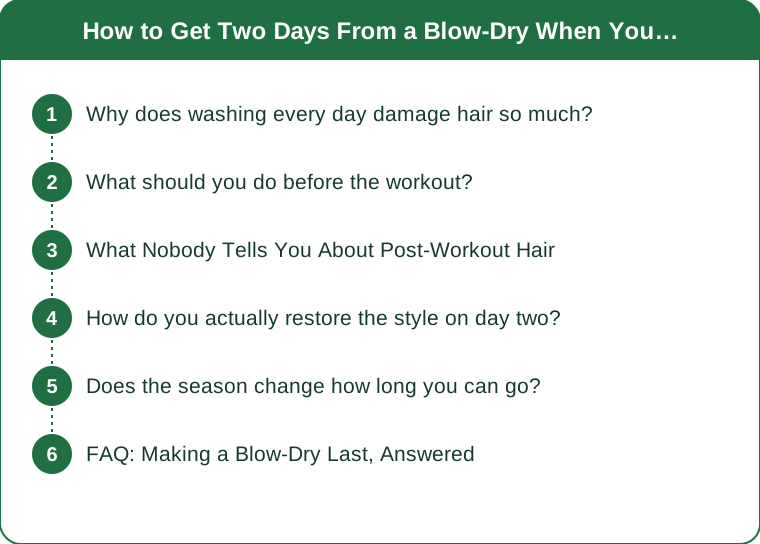
Why does washing every day damage hair so much?
Because the damage is cumulative and it comes from three places, not one.
Wet hair is at its most fragile. The hair shaft swells with water and the internal bonds weaken. Brushing, tying, or rubbing wet hair causes far more breakage than doing the same thing dry - this is the single largest source of mechanical damage for people who wash daily.
Shampoo strips the scalp’s oil. Daily stripping triggers compensatory oil production for many people, which produces the greasy-by-lunchtime cycle that then justifies more washing. The loop is self-sustaining.
Heat is the third. Daily blow-drying, particularly at high heat on wet hair, degrades the cuticle over months.
What sweat actually does: far less than people assume. Sweat is mostly water with salt, and while salt is drying on the hair shaft, sweat itself does not damage hair the way daily washing does. The scalp needs to be clean; the lengths mostly do not.
Which points to the actual strategy: manage the scalp, protect the lengths, and wash less often. The lengths of your hair have not been sweating.
What should you do before the workout?
This is where the second day is won, and it takes about two minutes.
Apply dry shampoo to the scalp before you train, not after. Counterintuitive and genuinely effective - it is a powder that absorbs oil and moisture, so it works better sitting in place ready than applied to a scalp that is already saturated. Focus on the roots at the crown and hairline.
Get everything off your neck and away from your face. The nape and the hairline are where sweat concentrates. A high bun or a braided crown keeps hair out of the sweat zone entirely.
Use a cotton or towelling headband, not a nylon one. The point is absorption. A synthetic headband traps sweat against the hairline and produces exactly the damp roots you are trying to avoid - and it contributes to the forehead breakouts that are a separate common complaint.
Use a fabric-covered or silk scrunchie, not an elastic. Standard elastics create a friction point at exactly the tension of a workout. Ponytail breakage is almost always at the elastic line, and it is the easiest fix on this list.
Vary where you tie it. Same position every day means the same stress point every day. Move it up or down two centimetres between sessions.
Do not tie it tight. Tension plus movement plus time is the combination behind traction-related thinning at the temples.
What Nobody Tells You About Post-Workout Hair
Drying the scalp fast matters more than anything you put on it. A damp scalp under tied-up hair for an hour is where the smell comes from - it is bacterial, not the sweat itself. Sixty seconds with a dryer on cool, aimed at the roots, prevents it entirely.
Do not leave it tied up while it dries. This is the most common mistake. A damp tied ponytail is a warm sealed environment, and it is why hair can smell hours after a workout despite having been washed the day before.
Air drying is not automatically gentler. For hair that stays wet a long time, the prolonged swelling of the shaft is itself damaging. A cool-air dry is often kinder than two hours of slow air drying, particularly in autumn when hair takes noticeably longer to dry.
The scalp itch a few hours after training is usually sweat salt and product residue, not dirt. A quick rinse of the scalp only - no shampoo - fixes it and preserves the style far better than a full wash.
Rinsing without shampoo is a legitimate option and is much underused. Water alone removes most salt and sweat from the scalp; the style survives if you keep the lengths dry and dry the roots afterwards.
Your hairstyle fails in evening workouts more than morning ones because the style has had a full day of oil, product, and handling before you even start. If you can train in the morning on second-day hair, it holds far better.

How do you actually restore the style on day two?
In order, and it takes about five minutes.
1. Cool air at the roots first. Lift sections and blast the scalp for thirty to sixty seconds. This alone revives a flattened root better than any product.
2. Dry shampoo, second application. Roots only, and leave it for two minutes before touching it - most people brush it through immediately and get powder rather than absorption. Then brush thoroughly.
3. Reshape with heat only where needed. A few sections around the face with a brush and dryer, or a quick pass with a straightener at the roots. You do not need to redo the whole head - the parts people see are the front sections and the crown.
4. A tiny amount of oil or serum on the ends only. Ends get dry and dull on day two while roots get oily. Different problems, different halves of the hair.
5. Change the style rather than restoring it. Day two is when a half-up, a low bun, or a braid does more work than trying to recreate day one. Second-day hair holds a style better than clean hair does - it has grip.
If the roots are genuinely too oily, wash the front sections only at the sink and blow dry them. A partial wash is a real technique and it buys another day.
Does the season change how long you can go?
Noticeably, and in a helpful direction.
You sweat less as it cools, which is the obvious one. Indoor training in a cool gym in October produces far less scalp sweat than the same session in August, and hair goes an extra day almost automatically.
But hair takes considerably longer to dry. Cooler air, less airflow, higher indoor humidity from heating cycles. Damp hair that used to dry in an hour can take three, which makes the immediate cool-air dry after training more important, not less.
Never go outside with wet hair in cold air. Not for the old wives’ tale reasons - wet hair in cold air is at its most fragile, and the physical stress of cold on a swollen hair shaft is where breakage happens. Dry it, or cover it.
Indoor heating dries the scalp and the lengths. A scalp that was oily in summer can go flaky in November, and the answer is usually less washing rather than more. A weekly scalp oil helps.
Static becomes the day-two problem. Dry air plus synthetic gym clothes plus a hat produces flyaways that were not there in summer. A light oil on the lengths and a natural-fibre hat handles most of it.
Hat season is coming. Hats compress and flatten, and hat friction at the hairline is a real cause of breakage. A silk-lined hat, or a silk scarf underneath, removes the friction entirely.
FAQ: Making a Blow-Dry Last, Answered
How often should I actually wash my hair if I train daily?
For most hair types, two to three times a week, with scalp-only rinses in between as needed. Very fine or very oily hair may need more; textured or curly hair usually needs less.
Does dry shampoo damage hair?
It does not damage the hair shaft, but buildup on the scalp can cause irritation and flaking if you never wash it out. Use it between washes, not instead of them.
Should I wet my hair before swimming?
Yes - hair saturated with clean water absorbs less chlorinated water. Add a leave-in conditioner and a cap.
What about washing just the roots?
Completely legitimate and very effective. Shampoo the scalp at the sink, avoid the lengths, and you keep most of the style.
Is a silk pillowcase worth it?
For friction reduction overnight, yes - it genuinely reduces breakage and helps a style hold to day two. It will not do anything for growth, despite the claims.
My hair still smells after washing. Why?
Usually product buildup or bacteria that survive a normal shampoo. A clarifying shampoo once every couple of weeks resolves most cases. If it persists alongside scalp irritation, see a professional - this is general information, not medical advice.
TL;DR:
- Damage from training is mostly washing and friction damage, not sweat damage - the lengths have not been sweating.
- Dry shampoo goes on before the workout, on a dry scalp, so it absorbs as sweat is produced.
- Cotton headband, silk scrunchie, hair off the neck, and vary where you tie it.
- Dry the scalp within a few minutes - sixty seconds of cool air prevents the smell entirely. Never leave it tied up damp.
- Day two: cool air at the roots, dry shampoo left for two minutes, reshape the front only, oil on the ends.
- Autumn means less sweat but much slower drying - and never go out with wet hair in cold air.
The reframe that makes all of this easier: you are not trying to keep your hair clean through a workout. You are trying to keep the scalp dry and the lengths untouched, and those are two much smaller problems.
Keep Reading
This article is for general informational and styling purposes only. Fit, sizing, and product availability may vary.