Why Your Hair Dries Differently at the Gym Than at Home
Quick Answer: Three things differ between a gym shower and your bathroom: the water is often harder, the communal dryers run hotter and are usually only high heat, and you almost never let hair air dry to 80% before styling. Hard water leaves mineral deposits that make hair feel coated and rough, high heat on soaking hair causes more damage than the same heat on damp hair, and rushing the process locks in whatever shape it happened to be in. All three are fixable with things that fit in a bag.
At home it dries fine. At the gym it comes out rough, flat and doing something unfamiliar.
Nothing changed about your hair. Four things changed around it.

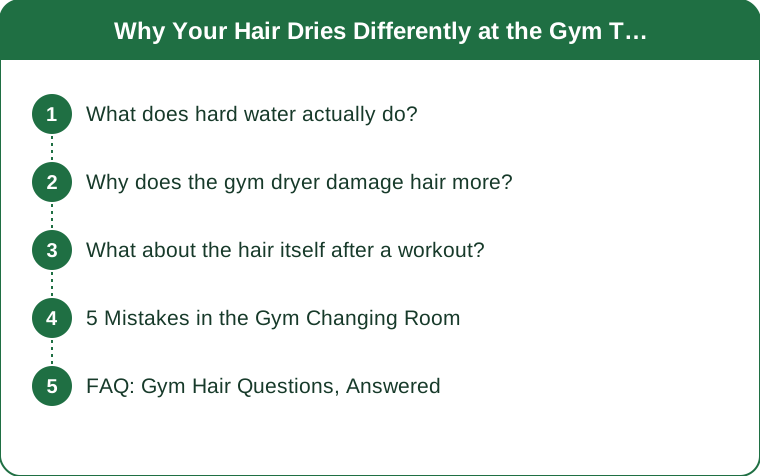
What does hard water actually do?
It deposits minerals on the hair shaft that shampoo does not remove.
Hard water contains dissolved calcium and magnesium. These bind to the hair’s surface and to the fatty acids in most shampoos, forming a residue - the same residue that leaves limescale on a kettle, deposited on your hair instead.
The physical effects are consistent and recognisable:
- A coated, slightly rough feeling when you run fingers through wet hair
- Reduced shine, because a rough uneven surface scatters light instead of reflecting it
- Products working less well - shampoo lathers poorly and conditioner sits on top rather than absorbing
- Colour-treated hair fading faster and sometimes shifting in tone
- Increased tangling during and after washing
Water hardness varies enormously by area and even by building. A gym on a different water supply from your home can be meaningfully harder, and older plumbing adds its own mineral load. This alone explains a large share of the my hair is different at the gym experience.
What actually helps:
- A chelating or clarifying shampoo once a week, which contains agents that bind minerals and lift them out
- A final rinse with bottled or filtered water, which sounds excessive and takes 20 seconds with a small bottle
- A leave-in conditioner applied to wet hair, which provides a barrier and improves slip regardless of water quality
- A shower filter, if it is your own gym and management is amenable - most are not, but it is worth asking
The cumulative point matters. Mineral build-up is progressive. Someone showering at a hard-water gym five times a week for a month has meaningfully more deposit than someone doing it occasionally, which is why the effect creeps up rather than appearing suddenly.
Why does the gym dryer damage hair more?
Because it is hotter, has fewer settings, and you use it on wetter hair.
Wall-mounted communal dryers are typically high-output units with limited or no temperature control. Many run at a single high setting and are designed to dry hair fast rather than gently.
Heat damage to hair is a function of temperature and moisture content, and the moisture part is the one people miss. Water inside the hair shaft turns to vapour when heated rapidly. That vapour expands and pushes outward against the cuticle, causing microscopic damage sometimes described as bubble hair in severe cases.
Which produces the counterintuitive rule: high heat on soaking wet hair is worse than the same heat on damp hair. The more internal water there is to flash to vapour, the more damage.
The other differences:
- Distance. Wall dryers are fixed, so people hold hair close to the nozzle rather than the 15 to 20cm that is recommended
- No cool shot. The cool blast at the end of a home dryer sets the cuticle flat, which is a real effect and communal dryers rarely have it
- No diffuser or concentrator, so airflow is unfocused and hair gets blown in every direction
- Time pressure, which pushes people toward the hottest setting
A workable gym drying routine:
- Squeeze out water with hands first, then blot with a towel - do not rub
- Use a microfibre towel if you have one; cotton towels create friction and frizz
- Apply a heat protectant before any heat, which is the single most valuable item in the bag
- Let hair get to 70 to 80% dry before the dryer if there is any time at all
- Keep the dryer moving and at a distance, pointing downward along the hair rather than up into it
- Finish with the coolest setting available, even briefly
And if there is genuinely no time: a leave-in with heat protection, a microfibre towel and letting it air dry on the way home beats a rushed high-heat blast every time.

What about the hair itself after a workout?
Sweat, product build-up and the friction of tied-up hair all change what you are starting from.
Sweat is mildly salty and slightly acidic, and as it evaporates it leaves salt on the hair and scalp. Salt is drying and roughens the cuticle, which is why post-workout hair feels different from ordinary end-of-day hair before you have even washed it.
Scalp sweat also loosens sebum and moves it along the hair shaft, which is why hair can look greasy at the roots and feel dry at the ends after a session.
Then there is the mechanical factor. Hair tied tightly for an hour of movement is under constant tension and friction at the elastic point. That specific spot accumulates damage - it is where most people find breakage.
Practical adjustments:
- Use a fabric scrunchie or spiral elastic rather than a thin band with a metal join
- Vary the height of the ponytail between sessions so tension does not land in the same place
- Braid rather than ponytail for high-impact activity, which distributes the tension
- Rinse the scalp even if you are not washing properly - plain water removes most of the salt
On dry shampoo, which is the standard gym answer: it absorbs oil and does not clean. Used repeatedly without washing it builds up on the scalp, which can cause itching, flaking and follicle irritation. Two consecutive days is a reasonable limit before an actual wash.
How often to wash is genuinely individual. Daily washing is fine for many people with a gentle shampoo, particularly if you are training daily and sweating heavily. The advice to wash less often is aimed at people who are not sweating into their scalp five times a week.
A middle option worth knowing: co-washing or rinsing with conditioner only. It removes salt and sweat with far less stripping than shampoo, and works well as an every-other-day option between proper washes.
5 Mistakes in the Gym Changing Room
1. Rubbing hair dry with a cotton towel. Friction on wet hair, when the cuticle is at its most open and vulnerable, is the fastest route to frizz and breakage. Squeeze and blot instead, and carry a microfibre towel - it takes no space and makes a visible difference.
2. High heat on soaking wet hair. Internal water flashing to vapour is what causes the worst heat damage, so the wetter the hair, the more harm the same dryer does. Get to 70 to 80% dry first, even if it means a few extra minutes.
3. Skipping heat protectant because it is just the gym dryer. Communal dryers are usually hotter and less controllable than home ones, so the case for protectant is stronger, not weaker. It is the highest-value item in the bag.
4. Relying on dry shampoo for days on end. It absorbs oil rather than cleaning, and repeated use builds up on the scalp, causing itching and flaking. Two consecutive days is a sensible ceiling before a proper wash.
5. Tying hair in the same tight spot every session. Constant tension and friction at one point along the shaft is where breakage concentrates. Vary the height, use a fabric scrunchie, and braid for high-impact work.
A sixth that fixes hard water without any equipment: a final rinse from a small bottle of filtered water. Twenty seconds, and it removes the mineral-heavy last contact that leaves hair feeling coated.
FAQ: Gym Hair Questions, Answered
Why does my hair feel coated after a gym shower?
Almost always hard water. Dissolved calcium and magnesium bind to the hair surface and to shampoo residues, leaving a mineral film that feels rough and dulls shine. A weekly chelating shampoo and a filtered final rinse both help.
Are wall-mounted gym dryers really worse?
Generally yes - they run hot with limited or no temperature control, have no cool shot, and are fixed so people hold hair too close. The damage comes mostly from using that heat on very wet hair rather than from the dryer itself.
Should I wash my hair every time I work out?
If you sweat heavily into your scalp, washing daily with a gentle shampoo is entirely reasonable. The advice to wash less often is aimed at people who are not doing that. Conditioner-only rinsing is a good middle option on lighter days.
How long can I use dry shampoo before washing?
Two consecutive days is a sensible limit. It absorbs oil rather than removing it, and build-up on the scalp causes itching, flaking and follicle irritation. Rinsing the scalp with plain water is better than another application.
What is the single most useful thing to carry?
A heat protectant spray, followed closely by a microfibre towel. The first addresses the biggest damage source and the second addresses the second biggest, and together they weigh almost nothing.
Why is my hair greasy at the roots and dry at the ends after training?
Scalp sweat loosens sebum and carries it along the shaft, while evaporating sweat leaves drying salt on the lengths. So the two ends of your hair genuinely are in different states, and treating them the same is why neither improves.
TL;DR:
- Gym water is often harder, leaving mineral deposits that feel coated and dull shine
- Communal dryers run hot with no cool shot, and high heat on soaking hair is the worst combination
- Get to 70 to 80% dry before any heat, and always use a protectant
- Squeeze and blot with microfibre - never rub with a cotton towel
- A 20-second filtered water final rinse fixes most of the hard water problem
- Vary ponytail height and use fabric elastics; breakage concentrates at one tension point
- Dry shampoo absorbs oil, it does not clean - two days maximum
The hair did not change. The water, the dryer and the timing did.
Keep Reading
This article is for general informational and styling purposes only. Fit, sizing, and product availability may vary.