Why the Same Hairstyle Holds at 7am and Falls Apart at 7pm
Quick Answer: Morning hair is clean, slightly rough, and grips itself. By evening it has picked up scalp oil, product residue, and humidity, and it has usually been tied and untied several times - all of which make the strands slicker and the elastic slide. The fix is not a tighter elastic. It is adding grip back: a light texture spray or dry shampoo at the roots before you tie, a fresh elastic rather than the one that has been on your wrist all day, and a two-stage tie that anchors the base separately from the length.
You wore the exact same ponytail this morning and it did not move.
Now you are ten minutes into an evening session, retying it for the third time, and wondering what you did differently. Nothing. That is the frustrating part.
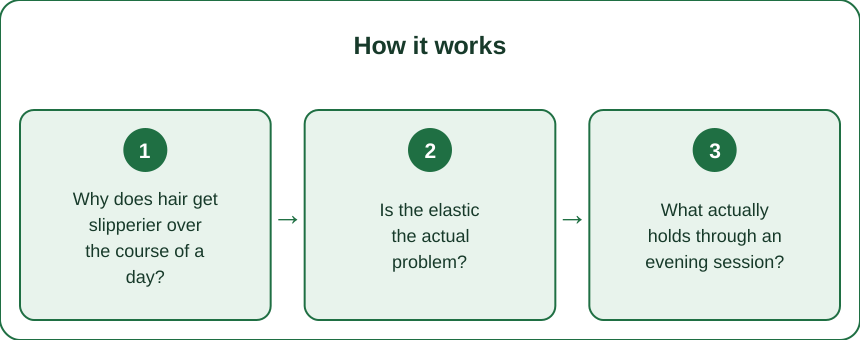
Why does hair get slipperier over the course of a day?
Scalp oil migrates down the strand continuously. Sebum production does not stop when you leave the house - it travels from the root outward over hours, coating the shaft in a thin, genuinely slippery film. By evening, the first several inches of hair are measurably smoother than they were at breakfast.
Product breaks down and redistributes. Whatever you used in the morning has been warmed by your scalp, compressed by a commute, and touched by your hands dozens of times. Hairspray that held at 8am has usually softened by 6pm, and softened hairspray adds slip rather than grip.
Humidity swings both ways and neither helps. In damp air the cuticle swells and strands slide against each other. In dry, air-conditioned buildings the hair picks up static, and static-charged strands repel each other rather than staying in a bundle.
Every retie loosens the surface. Each time you pull an elastic out you drag it against the cuticle, and each pass leaves the outer layer slightly flatter and slicker than before. Three reties over a day is a real change in surface texture, not an imagined one.
And your hair is warmer by evening. Warm hair is more flexible, which sounds good and is not - flexible strands compress under an elastic and then relax, leaving the tie looser than when you fastened it.
Is the elastic the actual problem?
Partly, but not the way most people assume. A fresh elastic and a used one are different tools, and the one that has been on your wrist since morning is the worse of the two.
Elastic loses tension with heat and stretch. Body heat from your wrist, plus whatever stretching it did around your hair this morning, means it is returning less force by evening. It looks identical. It is not performing identically.
Wrist elastics also pick up skin oil and lotion, which is exactly the surface treatment you do not want on something meant to grip.
Thicker is not automatically better. A wide, soft elastic distributes pressure comfortably but grips slick hair poorly. A thinner elastic with a fabric-wrapped surface usually holds better on evening hair, at the cost of a little more tension on the strands.
Spiral coil ties are the common exception people get wrong. They are excellent for avoiding creases and headaches and genuinely poor at holding slick hair through a hard session - they are a low-friction design by nature.
Keep a dedicated training elastic in your bag rather than on your wrist. It is a trivial change and it is the single most reliable one in this entire article.
What actually holds through an evening session?
Add grip before you tie, not after it fails. A light mist of dry shampoo or texture spray at the roots and through the mid-lengths gives the strands something to hold onto. You are not cleaning anything - you are deliberately roughening a surface that has become too smooth.
Give it thirty seconds to absorb. Product applied and immediately tied over just moves the slip somewhere else. Spray, wait, tousle with your fingers, then tie.
Use a two-stage tie for anything above shoulder length. Secure the base with one elastic, then add a second elastic three to four inches down the length. The second tie stops the ponytail swinging as a single heavy pendulum, and that pendulum motion is what works the base loose.
Tie damp-adjacent, not wet and not bone dry. If you have time, a very light spritz of water plus texture product gives the best hold. Fully wet hair dries into a looser configuration than it was tied in.
Braid instead of tying for high-impact work. A braid distributes the load along its length rather than concentrating it at one point, which is why it survives running and plyometrics when a ponytail does not.
And redo the style rather than tightening it. Pulling an already-loose elastic tighter concentrates all the tension on strands that are already stressed, which is how evening workouts turn into breakage at the tie point over months.
5 Mistakes That Guarantee an Evening Style Fails
1. Using the wrist elastic. It has been warmed, stretched, and oiled all day. It is the least capable version of that elastic and it is the one everyone reaches for.
2. Tying over freshly applied product. Serum, leave-in, or oil applied before a workout does the opposite of what you need. Any slip-adding product belongs after training, not before.
3. Tightening instead of restyling. Each incremental tug adds tension without adding grip, and the tension lands on strands that have already been compressed for hours. This is the habit most associated with the thin, broken halo at the tie point.
4. Tying the same spot as this morning. The hair at that exact height has already been compressed and abraded once today. Move the base an inch up or down - it grips better and it spreads the mechanical wear.
5. Skipping the second elastic on long hair. A long ponytail is a weight on a lever arm, and every step you take is an input into it. One tie at the base is fighting physics; two ties change the physics.
And a bonus one nobody mentions: taking your hair down at your desk in the afternoon and retying it before you leave. That last retie is usually the one that fails, because it was done quickly, in a mirror-free environment, on the slickest hair of the day.
FAQ: Evening Workout Hair, Answered
Why does my ponytail slip only in evening workouts?
By evening your hair has picked up scalp oil, softened product, and the abrasion of several reties - all of which make the surface slicker. The style is the same; the hair it is holding is not.
Should I use a tighter elastic instead?
No. Tighter concentrates stress on already-compressed strands and is the most common cause of breakage at the tie point. Add grip with texture spray or dry shampoo instead, and use a fresh elastic.
Does dry shampoo work if my hair is not greasy?
Yes, and this is the underused case. Used before an evening session it adds texture and grip rather than absorbing oil. A light mist at the roots and mid-lengths is enough.
Is a braid actually better than a ponytail for training?
For high-impact work, yes. A braid distributes load along its length instead of concentrating it at one point, so it survives running and jumping far better than a single tie.
Why does my second elastic make such a difference?
It stops the ponytail swinging as one heavy pendulum. That swinging motion is the force that works the base tie loose, and shortening the effective lever arm removes most of it.
Should I wash my hair before an evening workout?
If you have time, a rinse and rough dry gives you the grippiest surface of the day. If you do not, texture product achieves most of the same effect in thirty seconds.
TL;DR:
- Evening hair is slicker than morning hair because of migrated scalp oil, softened product, humidity, and the abrasion of repeated reties.
- The wrist elastic is warmed, stretched, and oiled - keep a dedicated training elastic in your bag instead.
- Add grip before tying: dry shampoo or texture spray at the roots, thirty seconds to absorb, then tie.
- Use a second elastic three to four inches down the length to kill the pendulum swing that loosens the base.
- Restyle rather than tighten - incremental tugging is what causes breakage at the tie point over time.
Your 7pm hair is a different material than your 7am hair. Treat it like one and it behaves.
Keep Reading
This article is for general informational and styling purposes only. Fit, sizing, and product availability may vary.