Why Your Workout Hair Routine Stops Working in Late August
Quick Answer: Late August breaks workout hair routines for two opposite reasons at once. Outdoor humidity is falling while indoor air conditioning dries the air further, so hair that was heavy and cooperative in July becomes flyaway and static-prone - and grip products that relied on some moisture stop holding. At the same time, a summer of sun, chlorine, salt and daily tight styling has left the hair genuinely more damaged, which means more breakage at the exact points your usual style puts tension on. The fix is a lower-tension style plus a routine change, not a stronger elastic.
The braid that held through every session in July is coming loose by the second exercise. There are new short hairs around your hairline that were not there in June. And the whole thing feels drier and less cooperative than it did a month ago.
All of that is the same story arriving in three forms.

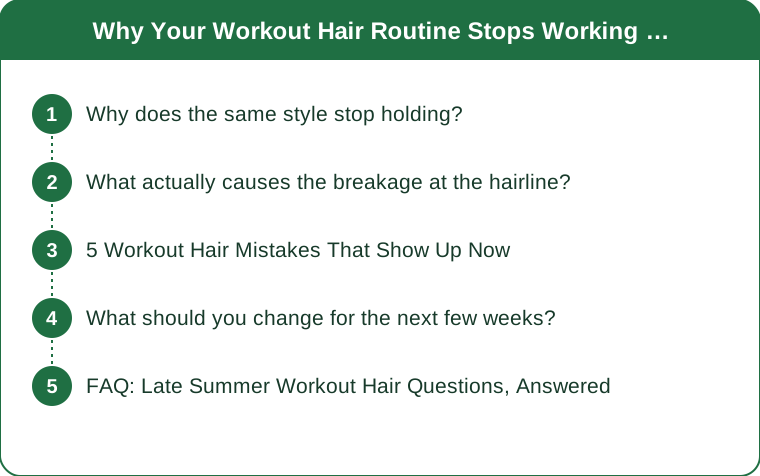
Why does the same style stop holding?
Because the hair itself changed, and so did the air.
Humidity affects hair through hydrogen bonding. In humid air, hair absorbs moisture, becomes heavier and holds a shape more readily - which is also why it frizzes. In drier air the opposite: lighter, more static-prone, and more inclined to slip out of a hold.
Late August starts the shift toward drier air in most of the country, and indoor cooling accelerates it. Static is the tell. If you are seeing flyaways that stand up rather than curl out, that is dry air, not damage.
The damage side is separate and additive. A summer of UV degrades the protein structure and roughens the cuticle, chlorine and salt strip lipids, and daily tight styling adds mechanical stress at fixed points.
That combination produces a specific and recognizable outcome: short broken hairs at the hairline, the crown and wherever your elastic habitually sits. Those are not baby hairs and they are not new growth - they are breakage, and they mark exactly where the tension has been.
The practical consequence is that the style that worked all summer is now being applied to hair that is more fragile and less cooperative. Continuing with the same approach is how a minor issue becomes a visible one by October.
What actually causes the breakage at the hairline?
Repeated tension at the same point, made worse by doing it on wet or damaged hair.
Hair is far more vulnerable when wet - the internal hydrogen bonds are disrupted and the strand stretches much more before breaking. Pulling wet hair into a tight style, or working with wet hair after a shower before training, applies stress to the strand at its weakest point.
Tension traction at a fixed point is the other half. A high ponytail in the same position every day concentrates force on the same follicles, and sustained traction over months can produce genuine follicular stress, not just breakage - which is why the professional recommendation is always to vary the position.
The elastic material matters more than people expect. Anything with a metal join, or a thin elastic with a fabric wrap that has worn through, catches and snaps individual strands each time it goes on and off. Over a summer of daily use, that is hundreds of small breaks in the same band.
Spiral coils and wide fabric scrunchies distribute the force over a broader area, which is why they produce less breakage at the same holding strength.
And sweat is a factor in its own right. Salt in sweat is drying and it crystallizes as it evaporates, which increases friction between strands. Hair that has dried in a tight style with sweat still in it is being abraded every time it moves.

5 Workout Hair Mistakes That Show Up Now
1. The same style, in the same place, every session. Traction is cumulative and position-specific. Alternate between high, mid and low, and between a ponytail and a braid, so no single set of follicles takes all of it. This is the single highest-return change.
2. Tying it up wet. Wet hair stretches far more before breaking. If you train after a shower or wash before the gym, wait until it is at least mostly dry, or use a loose style that puts no tension on it.
3. Leaving sweat in overnight. Sweat is salty and it crystallizes, increasing friction and drying the strand. Rinsing with water alone after a session - no shampoo needed - removes most of it and is far better than nothing on days you do not wash.
4. Using the same elastic all summer. Elastics degrade. A stretched-out band gets pulled tighter to compensate, which is more tension in the same place. Replace them seasonally and throw away anything with an exposed metal join.
5. Treating dryness with more product instead of less tension. Serums and oils help the surface, but they do not stop mechanical breakage. If you are seeing short broken hairs, the answer is a looser style, not a better leave-in.
What should you change for the next few weeks?
Reduce the tension, add moisture back, and adapt to drier air.
Switch to lower-tension styles. A loose braid, a low bun with a spiral coil, a claw clip for lower-intensity sessions. A style that holds through a session without being tight is the goal - if you can feel it pulling at the hairline, it is too tight regardless of how well it holds.
Add a weekly moisture or protein treatment, depending on what the hair is telling you. Stiff and snapping means it needs moisture. Limp and over-stretchy means it needs protein. Most late-August hair after a chlorine-heavy summer needs a bit of both, alternating.
Use a leave-in before training, not after. A light leave-in conditioner acts as a lubricant between strands and reduces the friction that tight styles and sweat create. Applied before, it is protecting during the session rather than repairing after.
Rinse after every session, wash two to three times a week rather than daily. Daily shampoo through a summer of chlorine exposure is a common contributor to the dryness people blame on the pool alone.
And for the static: a silk or satin scrunchie rather than cotton, and a silk pillowcase if the flyaways are worst in the morning. Both reduce friction, which is what static is.
FAQ: Late Summer Workout Hair Questions, Answered
Are the short hairs at my hairline breakage or new growth?
Breakage tends to be uneven in length, dry-feeling and located exactly where your usual style sits. New growth is finer, softer, tapers to a point, and appears more evenly across the hairline. If the short hairs form a band where your elastic goes, that is the answer.
How often should I actually wash workout hair?
Two to three times a week for most hair types, with a plain water rinse after every session in between. Water alone removes most of the salt from sweat, which is the main thing that needs to come out, without stripping the lipids that a summer has already depleted.
Does a tight style really cause hair loss, or just breakage?
Both are possible. Breakage is the common and immediately reversible one. Sustained traction on the same follicles over months can cause traction alopecia, which is much slower to reverse and in long-standing cases may not fully. Varying the style position is the prevention, and persistent thinning at the hairline is worth a professional opinion rather than a product.
TL;DR:
- Falling humidity makes hair lighter, more static-prone and less inclined to hold - the style did not fail, the air changed.
- A summer of UV, chlorine and salt leaves the strand genuinely more fragile at the same time.
- Short broken hairs where your elastic sits are breakage, and they map exactly where the tension has been.
- Vary the style position between high, mid and low - traction is cumulative and location-specific.
- Never tie it up wet, and rinse the salt out after every session.
- A looser style beats a better product when the problem is mechanical.
It is not a technique regression. Drier air plus a hard summer means the same routine now costs more than it did.
Keep Reading
This article is for general informational and styling purposes only. Fit, sizing, and product availability may vary.