Is Your Workout Ponytail Actually Causing Hair Thinning at the Temples?
Quick Answer: Daily tight ponytails or buns, especially at the same high tension point, can cause traction alopecia — gradual hair thinning at the temples and hairline from sustained pulling. Loosening tension and varying the style position reduces this risk significantly, and catching it early is fully reversible.
You’ve noticed slightly thinner-looking edges near your temples and assumed it was just stress or age. If your workout routine includes a daily tight ponytail in the same spot, the hairstyle itself is worth a closer look before assuming it’s something else.

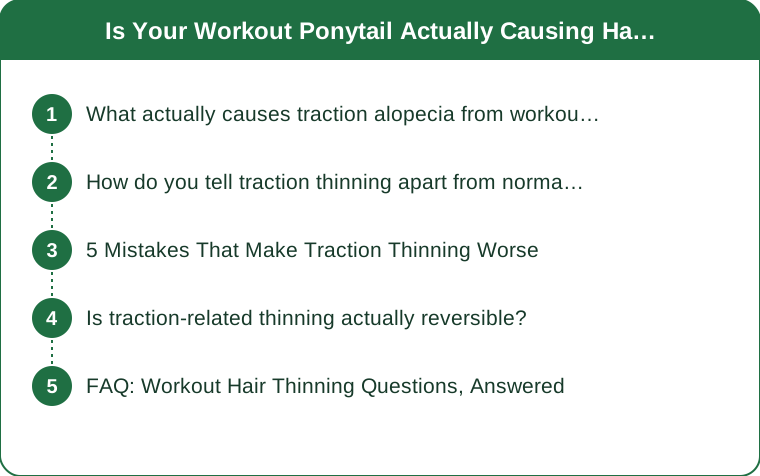
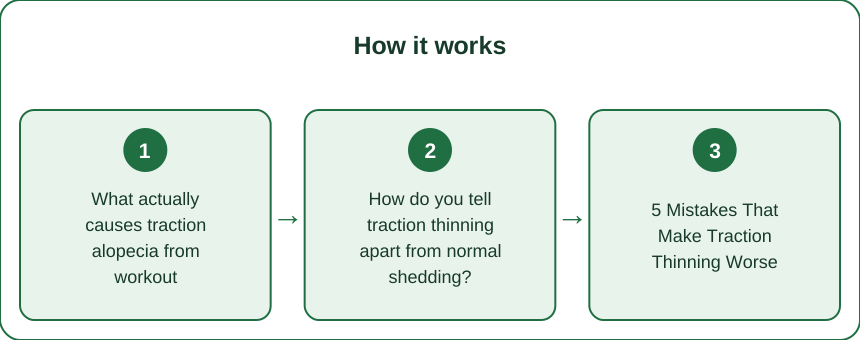
What actually causes traction alopecia from workout hairstyles?
Sustained tension at the same follicle points, repeated daily, gradually weakens the hair follicle’s anchor over months. Unlike shedding from stress or hormones (which affects hair broadly), traction alopecia shows a very specific pattern — thinning concentrated exactly where the pulling happens, usually temples and the hairline directly at the part.
Sweat and repeated tight styling for workouts specifically compound this, since damp hair under tension is more vulnerable to breakage at the root than dry hair styled once and left alone.
How do you tell traction thinning apart from normal shedding?
Pattern is the key signal: traction alopecia concentrates at the hairline and temples in the exact shape of your usual pull points, while general shedding (stress, hormonal, seasonal) is more diffuse across the whole scalp. If you can trace the thinning to where your workout hair tie or clip sits daily, that’s a strong traction signal.
Another clue: small bumps or tenderness at the hairline where tension concentrates, sometimes visible as tiny irritated follicles — a sign the mechanical stress is actively affecting the scalp, not just the visible hair.

5 Mistakes That Make Traction Thinning Worse
1. Same style, same tension point, every single workout. Varying the position (high pony one day, low bun the next, braid another) distributes tension across different follicles instead of concentrating it.
2. Pulling hair back when soaking wet from pre-workout hair wash. Wet hair is more fragile at the root — tie back after it’s mostly dry when possible.
3. Using thin elastic bands instead of fabric-covered scrunchies. Thin bands concentrate pulling force on fewer strands; softer, wider ties distribute tension more evenly.
4. Ignoring early tenderness at the hairline. Discomfort during styling is an early signal worth heeding, not just tolerating.
5. Assuming it’s unrelated to styling because it ‘runs in the family.’ Genetic hair thinning and traction alopecia can coexist — ruling out the styling factor is still worth doing.
Is traction-related thinning actually reversible?
Caught early (before follicles are permanently scarred), traction alopecia is often reversible once tension is reduced or eliminated — hair frequently regrows over several months. Caught late, after prolonged years of sustained tension, some follicle damage can become permanent, which is why early style changes matter more than a “wait and see” approach.
This is general information, not medical advice — a dermatologist can assess whether follicles are still viable and suggest specific regrowth support if thinning has progressed.
FAQ: Workout Hair Thinning Questions, Answered
How tight is too tight for a workout ponytail?
If you feel tension or a mild headache at the hairline immediately after tying it, it’s likely too tight — some snugness is fine, but persistent pulling discomfort isn’t.
Should I stop wearing ponytails for workouts entirely?
Not necessarily — varying the style, tension, and position day to day is usually enough; complete avoidance isn’t required if you rotate styles thoughtfully.
When should I see a dermatologist about workout-related thinning?
If thinning is visible, persistent over a couple months, or tender to the touch at the hairline, a dermatologist can assess follicle health early — earlier evaluation gives better odds of full regrowth. This is general information, not medical advice.
TL;DR:
- Traction alopecia shows a specific pattern — thinning exactly where a tight style pulls daily
- Rotate hairstyle position and tension rather than repeating the same tight pony every workout
- Tie hair back after it’s mostly dry, not soaking wet, to reduce root fragility
- Caught early, traction thinning is often fully reversible with lower-tension styling. This is general information, not medical advice.
Keep Reading
This article is for general informational and styling purposes only. Fit, sizing, and product availability may vary.